
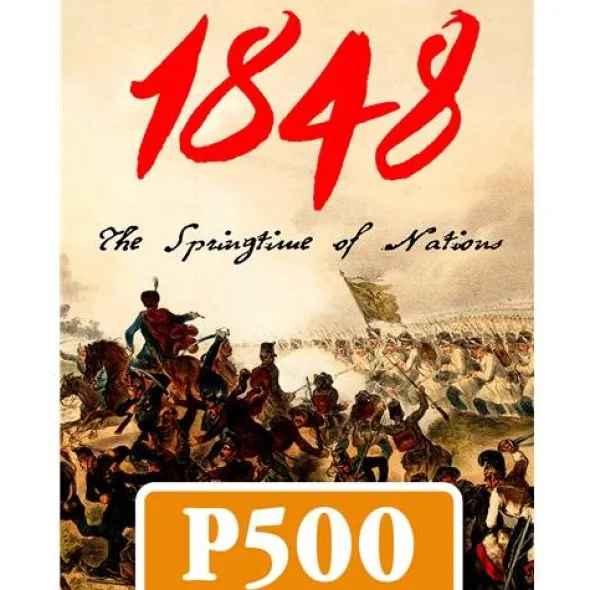
1848 – The Springtime of Nations (engl.)
€33.45
Contact data
Description
1848 – The Springtime of Nations (engl.) is an expert game for 2 players aged 14+ with a playing time of 150-180 minutes. Players take on the roles of Revolution and Counter-Revolution forces in 1848 Europe, battling for control through political and military means. The game features interlocking scoring regions and a unique Battle of Ideas system reflecting the era’s ideological conflicts.
33 years after the Congress of Vienna, Continental Europe still lives under the reactionary system designed by the Austrian Prince Metternich, the dominant figureof the age. Outside of England and France, absolute monarchy is the norm—and even in the latter, Louis-Philippe, the “bourgeois king,” is busy rolling back the people’s hard-fought liberties. In the east, the empires of the “Holy Alliance,” Austria, Russia, and Prussia, enforce ruthless repression against progressive ideas—whether nationalist, republican, democratic, liberal, or socialist. But the time is ripe for revolution, and the conflagration of 1848 will shake this old system to its core in awhirlwind of insurrection and new ideas. “People’s wars” will rage. Do you not feel, through a kind of instinctive intuition that cannot be analyzed but that is certain, that the ground is shaking once again in Europe? Do you not feel — how shall I call it? —that a revolutionary wind is blowing? – Alexis de Tocqueville, Souvenir (January, 1848)
1848: The Springtime of Nations is a 2-player CDG depicting the unprecedented wave of revolutionary activity that swept across Europe in the titular year of 1848. Based on the hit area control system pioneered by GMT’s 1989: Dawn of Freedom and Twilight Struggle, it pits the forces of “the Revolution” against those of the “Counter-Revolution” in a struggle to decide the future of Europe andthe world. The Revolutionary player controls the various insurgent and progressive movements trying to usher in a new order while the Counter-Revolutionary player leads theforces of reaction aiming to preserve the status quo. They will fightover and across the empires and nations of Europe, attempting tosuppress their enemy’s influence and extend their own through acombination of political and military force—all the while navigatingmyriad historical events of the time.
Revolution and Counter-Revolution: In the early game, theRevolutionary player will have the edge with many powerful events kickstarting revolutions — particularly by dominating the favorable terrain of Bourgeois and Worker spaces in the west of the map. The Counter-Revolutionary will have to strike out from their natural base inChurch and Aristocrat spaces in order to contest the proclamation of new Republics, but they can take heart in the fact that momentum willswing their way.
Nations and Empires: On the game’s map, players will find great multinational Empires at the height of their glory and burgeoning nations vying for their unity, independence, andliberty. Using the same regional scoring system as 1989, scoring regions are formed by the spaces belonging to France, Germany, Italy, Poland, and Hungary. In an original twist, however, a second set of regions is superimposed over these nations in the form of the Austrian, Russian, and Prussian empires. The result is an interlocking system of scoring regions, adding greatly to players’ strategic considerations.
The Battle of Ideas Replacing the Space Race of Twilight Struggleand the Tiananmen Square track of 1989, ideological conflict takes the stage in 1848: The Springtime of Nations through the Battle of Ideas. Both players will try to advance their agenda on the political, national, and social questions of the age inorder to gain powerful bonuses for their side.
Just ask us if you need more information about this item or if you can’t find a certain game in our shop.
Be the first to review “1848 – The Springtime of Nations (engl.)”
Related products
Brettspiele

Ab 16 Jahren
Ab 10 Jahren

Ab 12 Jahren
Ab 12 Jahren
Brettspiele
Adventskalender
Brettspiele


Brettspiele
Brettspiele

Brettspiele

Ab 12 Jahren

Brettspiele
Ab 12 Jahren
![365 Abenteuer - Cthulhu 1926 [Kalender Edition 2027]](https://spiele-shopsale.com/modeqaf/product_images/abenteuercthulhukalendere-2-0-247x196.webp)
Adventskalender

Reviews
There are no reviews yet.